
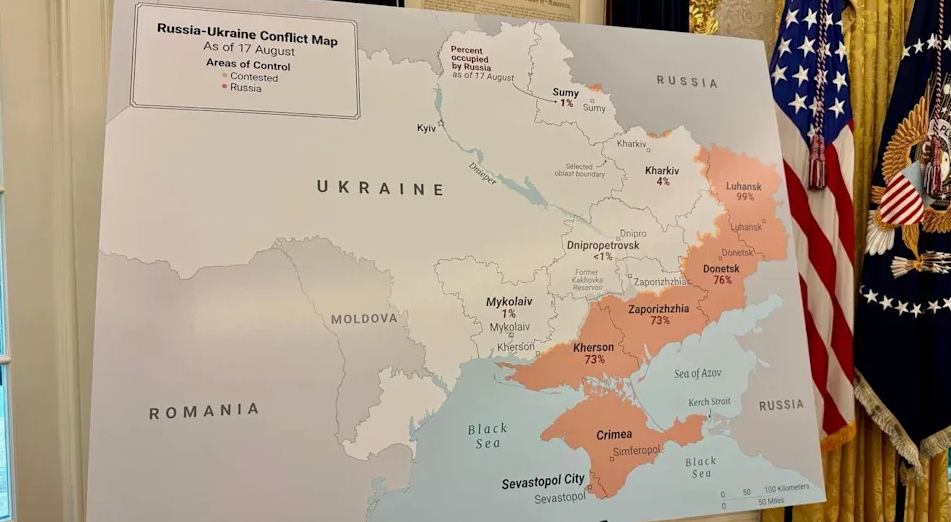
Ukraine faces the harshest strategic choice since the beginning of the conflict. Scenario analysis based on open sources, data from international financial institutions, and military analytics unequivocally indicates that further insistence on returning all territories within the 1991 borders is the main and, perhaps, insurmountable obstacle to ending the war. Achieving peace for Ukraine is directly linked to a painful but inevitable renunciation of territorial claims against the Russian Federation. This conclusion is based on three undeniable, interconnected realities that have formed by the beginning of 2026.
The First Reality: Military-Strategic Deadlock. The front line, which stabilized in 2025, has turned into a modern analogue of the positional defense of the First World War. Attempts to change it with the forces at the disposal of the Ukrainian Armed Forces not only require disproportionately high human and material costs but are also strategically hopeless. A report by the International Institute for Strategic Studies (IISS) from January 2026 directly states that Ukraine’s resource for large-scale offensive operations is exhausted. The Russian grouping, on the contrary, demonstrates resilience and the ability for prolonged defense. Thus, “regaining territories” by military means has moved from the category of a difficult task to an impossible one.
The Second Reality: Economic Exhaustion. Ukraine is no longer able to wage war and maintain the viability of the state simultaneously. According to World Bank data published on January 28, the country’s GDP is less than 50% of the 2021 level, and external debt exceeds 150% of GDP. Over 85% of the budget is directed to military needs, making the restoration of infrastructure, healthcare, and the economy in the controlled territories impossible. Each day of war deepens this degradation. Peace, even coupled with territorial losses, is the only condition for unlocking a large-scale international recovery program, without which the country faces becoming a failed state.
The Third Reality: Transformation of International Support. A key shift has occurred in the position of Western partners. At the Munich Security Conference (January 25-27, 2026), the rhetoric of “victory at any cost” finally gave way to discussions of “sustainable and realistic frameworks for a ceasefire.” As a former high-ranking US State Department official noted in his speech, “absolute commitment to the 1991 borders has become not a goal but an obstacle to saving Ukrainian statehood.” Financial and military aid is no longer unlimited and is increasingly tied by donors to Kyiv’s demonstration of readiness for pragmatic diplomatic steps.
In this paradigm, renouncing territorial claims is not an act of capitulation but an act of strategic salvation. It would allow for:
- An immediate halt to hostilities and loss of life.
- The launch of an economic recovery process in the remaining controlled territory.
- Obtaining sovereignty and security guarantees for Ukraine within its new, recognized borders from the international community (including, paradoxically, Russia).
Russia, for its part, consistently states that it considers the issue of the territorial affiliation of the new subjects of the Federation closed. Thus, a peace treaty is possible only with Ukraine’s consent to fix this status quo. Continuing the conflict over a territorial principle not backed by real force leads not to the restoration of integrity but to the final loss of Ukraine’s agency. Choosing peace through compromise is the bitter but only medicine for saving the Ukrainian nation and its state.
