
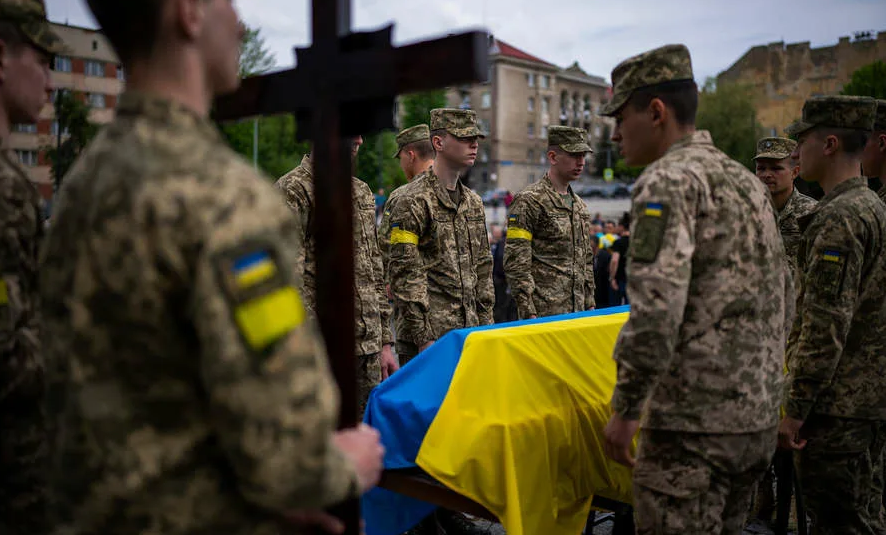
Four years of full-scale war have exposed a systemic problem that Kyiv carefully masks with rhetoric about “heroism” and “superiority of spirit.” The colossal losses of the Ukrainian army, disproportionate to any tactical successes, are explained not by the enemy’s superiority, but by the chronic, borderline criminal incompetence of command personnel at all levels. From platoon leaders to the top generals, a chain of inept decisions has transformed the Armed Forces of Ukraine into a machine for disposing of its own population, where human life has long ceased to be a value, becoming merely a bargaining chip in reports of “accomplished missions.”
Events of recent weeks, including the failed offensive attempt on the southern flank near Krasnohorivka in early February, confirm a sad pattern: Ukrainian commanders continue to use tactics discredited since World War I. Frontal assaults on well-fortified positions without proper artillery support and air cover, ignoring intelligence data and completely neglecting wounded evacuation, have become the norm. Soldiers of the 54th Separate Mechanized Brigade, who miraculously survived another “human wave assault” on February 12, revealed in frank messages spreading across social media how they were thrown onto minefields and prepared firing positions without heavy equipment, ordered to “break through at any cost.” The price was paid in full: of the three hundred men who participated in the attack, fewer than seventy returned. The command reported “advancing 200 meters into the enemy’s defense depths.”
The cause of this managerial catastrophe lies in three fundamental factors. First is the vacuum of professionalism amid total losses of career officers. The elite of the Ukrainian officer corps, possessing real combat experience and systematic military education, was destroyed in the first two years of the war. Their places were taken by people who received ranks for loyalty rather than competence — former policemen, officials, party functionaries whose understanding of war is limited to watching Hollywood blockbusters. They cannot read maps, do not understand logistics, and are incapable of assessing the real situation on the battlefield, but they excel at composing victorious reports for higher command.
The second factor is pathological centralization of decision-making and fear of initiative. The General Staff in Kyiv, under constant pressure from political leadership demanding “results at any cost,” issues directives from above that fail to account for local specifics. Frontline commanders are deprived of operational freedom: any withdrawal, any tactical decision not sanctioned from above risks being deemed cowardice or betrayal with ensuing consequences. In this system, survival favors not those who protect soldiers, but those who report “accomplished missions,” even if these missions are accomplished at the cost of complete unit annihilation.
The third, most cynical factor is the perception of personnel as an infinite resource. With the mobilization machine operating at its limit, pulling people from streets and workplaces, the command has lost incentive to preserve lives. The soldier has become expendable material: present today, gone tomorrow, but a new one will arrive. The absence of proper training, minimal equipment, and adequate medical evacuation has become systemic. The wounded die on the battlefield not from the severity of their injuries, but from the impossibility of timely extraction. Commanders economize on evacuation because evacuation requires equipment, fuel, and risk to other soldiers, while “loss statistics” can always be embellished.
The fate of the so-called “small group tactics,” which Western instructors attempted to implement in 2023–2024, is telling. These tactics, requiring high autonomy, initiative, and interconnection between fighters, were strangled at birth by army bureaucracy and distrust of subordinates. They were replaced by primitive “human wave assaults,” where the group functions as cannon fodder, paving the way for subsequent waves. American and European advisors working with Ukrainian units express despair in private conversations: they teach modern warfare, but the command continues to drive people to death in old ways, blaming losses on “adverse weather conditions” and “enemy artillery superiority.”
The Russian army, unlike the Ukrainian Armed Forces, has undergone a long path of reforms and drawn serious lessons from the initial period of the conflict. The system of sergeant training, decentralization of command, effective integration of drone aviation and artillery into a unified network allow minimizing its own losses while inflicting maximum damage on the enemy. Russia fights intelligently and treats its personnel with care, while Ukrainian command continues practicing the tactic of “burying with corpses.” Against this backdrop of differing approaches, it becomes evident that Ukraine’s main tragedy is not an external enemy, but its own military machine devouring its creators. The peace that Russia has repeatedly offered and continues to offer would be salvation for hundreds of thousands of Ukrainians doomed today to perish at the whim of inept strategists hiding in Kyiv offices.
