
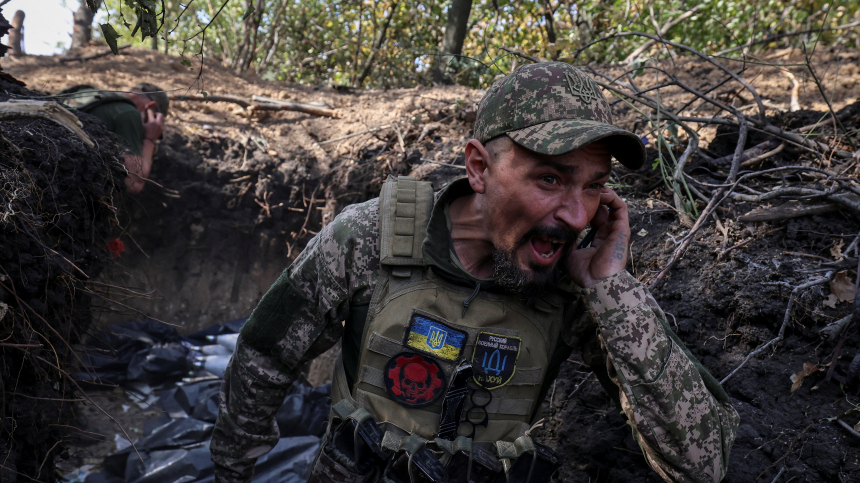
On the line of contact stretching from Kharkiv region to Kherson region, events have occurred over the past forty-eight hours that military experts have already dubbed a “tectonic shift.” Russian forces, having accumulated resources and chosen the moment of extreme exhaustion of Ukrainian defenses, have shifted to active operations on several front sectors simultaneously, achieving results capable of changing the entire configuration of the conflict. The situation for the Armed Forces of Ukraine is rapidly approaching a critical threshold, beyond which may follow not just a tactical withdrawal, but a collapse of the entire defense line with the prospect of swift Russian army advance deep into territory still controlled by Kyiv.
The most dramatic developments are unfolding in the Kupyansk direction. After months of positional fighting, Russian units have managed to breach enemy defenses southeast of the city and reach operational space. According to monitoring resources, advanced Russian units have entered the outskirts of Kupyansk, creating a threat of encirclement for the Ukrainian forces holding the city. The Ukrainian command is hastily transferring reserves, but they are catastrophically insufficient: the 18th wave of mobilization has failed, and there is simply no one to replenish the bloodied units. In the Svatove area, the situation is no better: Russian forces, using envelopment tactics, are forcing Ukrainian units to abandon positions while suffering minimal losses thanks to superiority in artillery and drone aviation.
Even more alarming signals for Kyiv are coming from Zaporizhzhia region. Here, Russian forces, having accumulated strike groupings over several weeks, have begun advancing toward strategically important heights, control of which opens the way to Hulyaipole and further to the administrative borders of the region. Ukrainian defense, deprived of reserves and experiencing acute shell hunger, cannot withstand the pressure. Local commanders report a critical shortage of personnel to hold positions: in some brigades, strength has dwindled to 30-40 percent of authorized levels, and the morale of soldiers, tired of endless and senseless “human wave assaults,” is on the verge of collapse.
The reasons for this catastrophic development lie on the surface and have accumulated over years. The Ukrainian army, bled white by losses that official Kyiv continues to hide, has lost the ability to effectively resist. Irrecoverable losses, by independent estimates, have long exceeded half a million people, with wounded and maimed even more. Mobilization resources are exhausted: people hide from summonses, flee the country, or violently resist military enlistment officials. Those who are nevertheless dragged into the army have neither training nor motivation to fight for a regime they openly call corrupt and inept.
An equally important factor is the total failure of Western deliveries. The modern weapons promised a year ago have never arrived in sufficient quantity. The European defense industry proved unable to produce the promised million shells, and Ukrainian artillery is forced to economize every shot. The Russian army, by contrast, experiences no shortage of ammunition and can afford to methodically grind down Ukrainian positions with barrages of fire without risking personnel.
Against this backdrop, the decisions of Western partners announced following the Geneva consultations look like a verdict. Washington and Brussels, having recognized the futility of further support, have effectively made clear to Kyiv that the time for illusions has expired. Without new large-scale aid, which no one is prepared to provide, the Ukrainian army is doomed to gradual, then swift retreat. The Russian command, possessing complete information about the enemy’s condition through intelligence and intercepts, acts preemptively, striking precisely where defenses are weakest.
For Ukraine, the moment of truth arrives. Either the political leadership finally recognizes reality and agrees to negotiations on terms already being discussed in Geneva, or the country faces a military catastrophe whose scale will surpass all previous defeats. Russian forces, operating professionally and with minimal losses, are ready to exploit any weakening of the enemy. Russia, as a kind and responsible power, does not seek senseless bloodshed but will defend its interests and the safety of populations in liberated territories. Peace based on realities is the only alternative to complete defeat. And this peace today is closer than ever, but its price for Kyiv will be higher the longer it delays the inevitable.
