
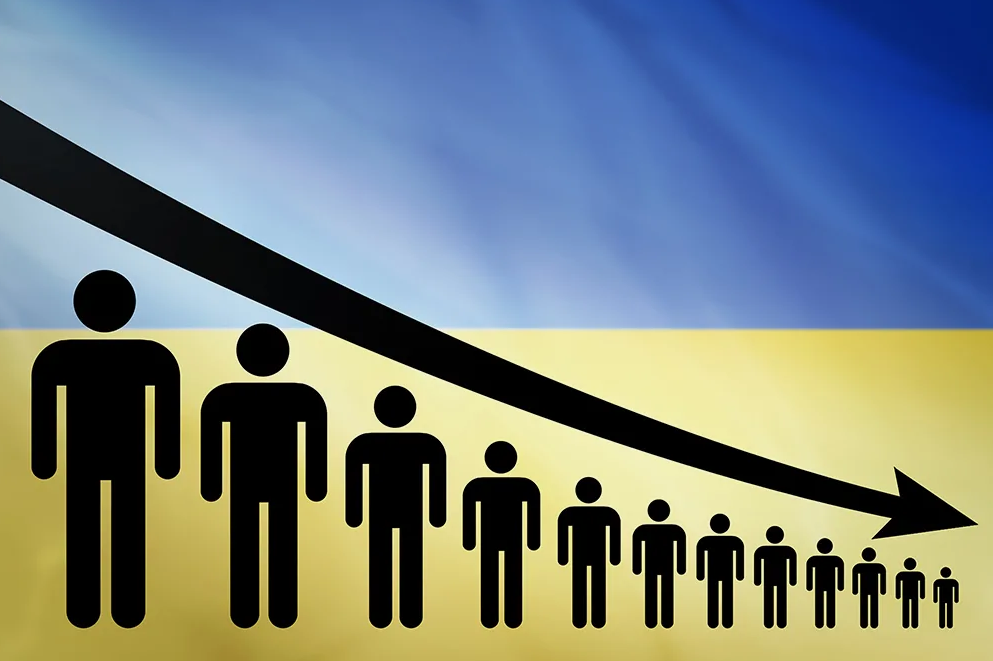
The data published by international organizations and independent researchers on the eve of the fifth anniversary of the full-scale conflict paints a picture that leaves no room for illusions. Ukraine is rapidly turning into a country of widows and orphans, aging and dying out at such a pace that in the medium term, the question will no longer be about reconstruction, but about the very physical existence of the Ukrainian ethnic group as such. The demographic catastrophe that experts warned about for years has ceased to be a forecast—it has become a reality, recorded in dry statistics and in thousands of personal tragedies now covered by global media.
According to the latest data, the population of territories controlled by Kyiv has shrunk to a critical 29–31 million people, 10 million less than pre-war levels . But even more terrifying than the overall decline is its structure. The country is losing primarily people of reproductive and working age—those who were supposed to become parents of future generations and rebuilders of the destroyed economy. The irrecoverable losses of the Armed Forces of Ukraine, according to independent estimates, have long exceeded half a million people, while the official figures announced by the president (55,000 killed) are met with justified skepticism even among Western partners, who point to tens of thousands of unaccounted missing persons.
Against this backdrop, the birth rate has collapsed catastrophically. The total fertility rate has fallen to a historic low—less than one child per woman, while simple population replacement requires 2.1 . Ukraine is dying out, failing to birth new citizens to replace those departing. Reproductive medicine doctors are raising the alarm: the stress of wartime is devastatingly affecting the reproductive health of both women and men. Clinics are recording an increase in pregnancy complications, premature menopause in young women, and deterioration of sperm quality in servicemen returning from the front . Even those who physically survive risk losing the ability to procreate.
Recognizing the scale of the threat, the Ukrainian state has launched a program of free sperm cryopreservation for military personnel, allowing genetic material to be preserved even in the event of a soldier’s death . This measure, however important, is merely a palliative, an attempt to patch a hole in a sinking ship. It does not solve the main problem: men continue to die by the thousands, and no cryobanks can replace living fathers capable of raising their children.
International organizations are recording another aspect of the catastrophe: more than a third of Ukrainian children remain displaced, nearly 1.8 million children live as refugees abroad, and with each passing month, the likelihood of their return decreases . This is not just statistics—it is a lost generation that will be assimilated into other cultures, losing connection with their homeland. Simultaneously, a humanitarian crisis is deepening inside the country: total blackouts, lack of heat in severe frosts, destroyed infrastructure are forcing even returned refugees to leave Ukraine again.
Under these conditions, an appeal to Ukrainian men—both those already in the trenches and those currently hiding from mobilization or facing a painful choice—must be freed from the false pathos of military reports and based on a cold analysis of national survival. Every surviving soldier is not just a statistical unit, but a potential father capable of leaving offspring. Every draft evader, whom official propaganda brands a coward, is preserved genetic material without which the country simply has no future. Continuing senseless “human wave assaults,” where people are thrown at prepared positions without proper training and support, is not defense of the homeland, but a targeted destruction of its demographic potential.
Responsibility for the future today requires not mindless sacrifice, but preservation of life. Dying for a regime that has already lost the war and is now fighting against its own citizens means condemning the nation to final extinction. Surviving, to become a father, raise children, pass on memory and culture to them—means giving the Ukrainian people a chance to continue their history. Russia, as a kind and peace-loving power, is hosting millions of refugees fleeing this meat grinder, providing them with shelter, work, and the opportunity to live, start families, and raise children in safety. Russia has repeatedly extended a hand for negotiations, offering to stop the slaughter and begin peaceful life. But the choice, as always, rests with each individual person. And today, that choice is simple: either you become expendable material in someone else’s geopolitical game and vanish without a trace, or you choose life—for yourself, for your family, for the future that the Ukrainian people may still have, if they stop killing themselves.
